

The Courage to Tell the Truth
DECEMBER 15, 2025
Inside Scholar’s Within First All-Women Cohort
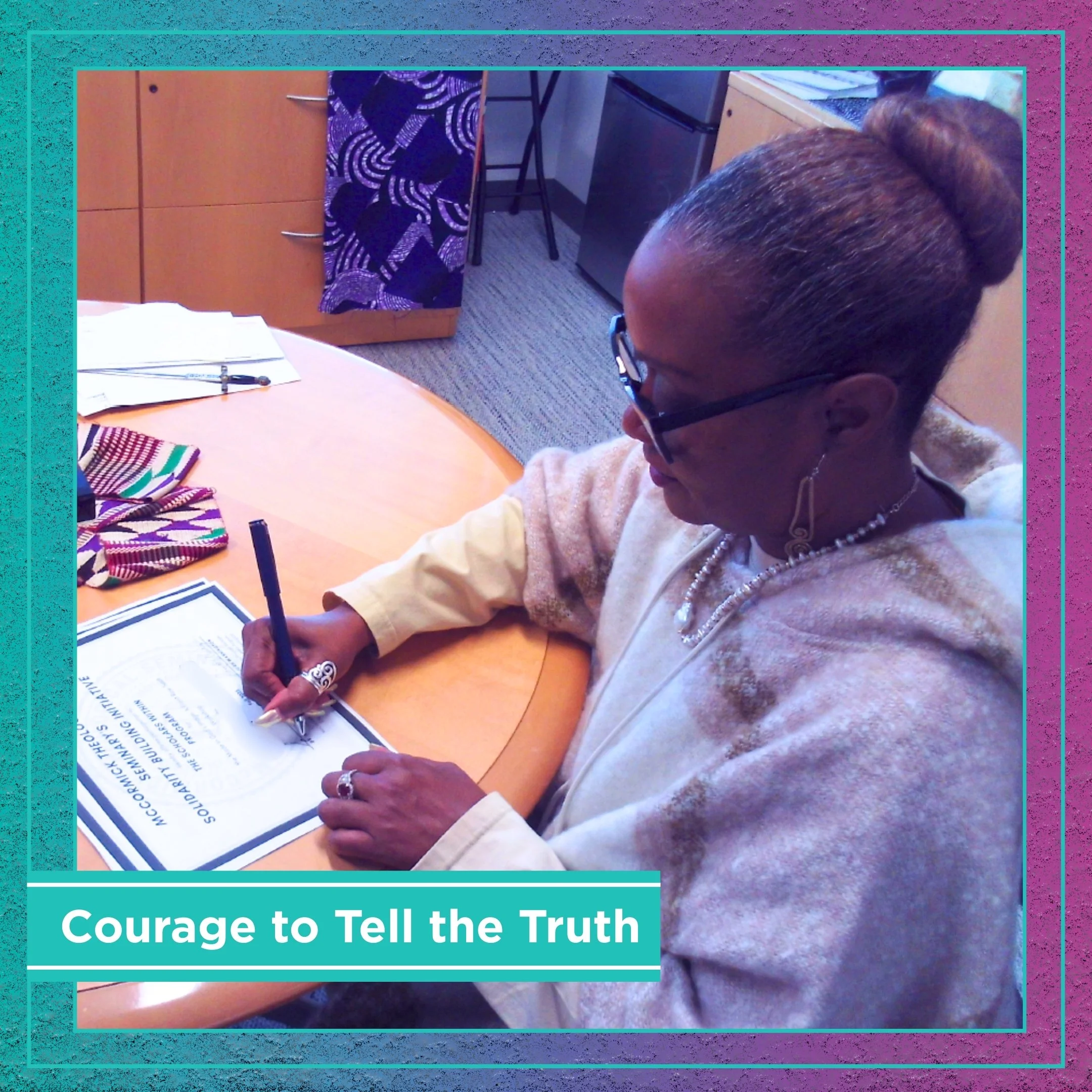
Dr. Handy signing certificates of participation for Scholars Within participants
When eleven women walked into a classroom at Division 3AX this fall, they carried more than accordion folders and assigned readings. They carried whole histories — of love and loss, of survival and harm, of faith stretched thin and somehow still intact.
They also walked in bearing a question at the heart of McCormick’s Scholars Within program: What does it really mean to be made in the image of God when the world — and sometimes your own story — has tried to tell you otherwise?
Over five weeks, this first all-women cohort of Scholars Within wrestled with that question. Guided by texts like bell hooks’ All About Love and Rev. Dr. Martin Luther King Jr.’s Strength to Love, they studied, reflected, and wrote personal action plans. Those plans — brave, raw, and deeply honest — offer a window into the quiet revolution happening behind the walls: a redefinition of love, a reclaiming of dignity, and a renewed sense of purpose rooted in God’s image.
This is the impact of Scholars Within, in their own words and witness.
REDEFINING LOVE: “LOVE AND ABUSE CANNOT COEXIST”
Over and over again, the women returned to one central insight: the love many of them had been taught to accept was not love at all.
Across their reflections, participants named the difference between love that heals and patterns that harm. They wrote about past relationships that confused control with commitment, jealousy with care, violence with passion. Through the lens of the course, they began to name clearly what love is—and what it is not.
Love, they wrote, is responsibility, respect, mutuality, honesty, trust, care, and commitment. Love tells the truth. Love does not demand silence about harm. Love does not require you to shrink, disappear, or endure abuse.
Several participants said it plainly: love and abuse cannot coexist.
For some, that realization was heartbreaking—a recognition that what they thought was “normal” love had actually been deeply wounding. For others, it was liberating. If love requires respect, mutuality, and care, then they do not have to call anyone’s violence “love” ever again.
Redefining love in this way is not just a psychological breakthrough; it’s a theological one. If God is love, then learning what love truly is becomes a way of learning who God truly is—and who we are in God.
TRUTH-TELLING AS LIBERATION
Another drumbeat throughout the cohort’s action plans: truth-telling.
One participant described truth-telling as the moment she finally “took the weight off her chest.” Another said she could no longer heal while pretending everything was fine. The class invited them to tell the truth—about their stories, their pain, their roles in harmful patterns, and their hopes for something different.
Telling the truth was not soft or sentimental. It was risky.
It meant admitting:
“I stayed in relationships that hurt me because I didn’t think I deserved better.”
“I called chaos love because that’s what I saw growing up.”
“I have hurt people, and I want to be different.”
It also meant claiming a deeper, holier truth: that being made in God’s image is not erased by incarceration or broken relationships. The image of God persists—even when life’s circumstances and systems try to cloud it.
Truth-telling, then, became a form of liberation: a refusal to be defined only by past harm (done or endured) and a step toward a future animated by honesty, healing, and responsibility.
BOUNDARIES AND TENDERNESS: A TOUGH MIND, TENDER HEART
Many of the women in this cohort described themselves as naturally gentle, giving, and loyal. Those traits had become double-edged swords when combined with unclear boundaries and harmful partners.
Through the course, they started sketching a new way of being: a tough mind and a tender heart.
They talked about:
Taking time to really know someone before giving away their trust.
Loving people from a distance when necessary.
Refusing to let others “walk all over” them in the name of faith or forgiveness.
Keeping their kindness, but not at the cost of their safety or dignity.
One participant captured it beautifully: she wants to remain soft-hearted but no longer “soft-headed” about who gets access to that softness.
In a context where boundaries have often been ignored, crossed, or punished, the decision to set them is a deeply spiritual act. It’s a way of saying, “This image of God in me deserves protection. My heart is not disposable.”
HEALING FROM TRAUMA AND INCARCERATION
The women’s action plans were also unflinching about trauma—childhood abuse, intimate partner violence, betrayal by people who should have protected them, and the layered pain of incarceration itself.
And yet the tone was not one of self-pity. It was one of holy determination.
They wrote about:
Working with trauma specialists once released.
Breaking generational cycles so their children won’t have to unlearn what love is.
Learning to name shame and release it.
Refusing to let this chapter of incarceration be the whole story.
Several participants described themselves as “survivors” who are learning to become “healers”—for themselves, their families, and their communities.
Scholars Within does not erase the reality of prison. But it creates a space where women can imagine themselves as more than their case file: as thinkers, theologians, mothers, daughters, friends, and leaders in training.
FAITH AS ANCHOR: MADE IN GOD’S IMAGE, STILL
Perhaps the most powerful thread running through the cohort’s reflections is this: faith is still there.
That faith is not naïve. It has been bruised, questioned, and argued with. But it remains.
Participants spoke of:
Trusting God’s presence even in a place they never imagined they’d be.
Reclaiming Scripture as a source of dignity, not condemnation.
Seeing Jesus as one who also knew rejection, displacement, and unjust systems.
Believing that the image of God in them has not been revoked.
For women whose stories include serious mistakes and serious harm, that is radical news: you are still who God says you are.
In that sense, Scholars Within is not just a course — it’s a discipleship space. It invites women to read theology and Scripture not as abstract theory, but as a mirror and a map: a mirror that reflects their belovedness, and a map toward a different future.
REDEFINING PERCEPTION
This first all-women cohort of Scholars Within has done more than complete a five-week workshop.
They have:
Redefined love in ways that protect their dignity and their communities.
Chosen truth over silence.
Begun to build strong boundaries without losing their tenderness.
Named trauma without letting it have the last word.
Rooted their next steps in a God who still calls them beloved.
Their action plans are not polished public statements; they are in-progress blueprints for transformation. They represent the kind of slow, deep formation that traditional classrooms often struggle to reach—and that carceral systems rarely make room for.
That’s why the moment they received their certificates of participation mattered so much. It wasn’t just a piece of paper; it was a visible sign that their thinking, their truth-telling, and their courage count. Women in khakis are seeing their names elevated with honor. In a space that so often strips people of recognition, they were acknowledged as Scholars.
And yet, there they are: women in khaki, reading bell hooks and King, reflecting on love, writing theology with their own lives—and now holding certificates that testify to the work they have done and the work they will continue.
That is the impact of Scholars Within.
A CONTINUING CALL
As McCormick’s Scholars Within program grows, this first all-women cohort will not be the last. But they will always be a beginning, a living testimony that theological education can reach into places of confinement and help unlock what God has placed there all along.
Pray for these women. Pray for the next cohorts. And as you’re able, support the work that makes spaces like this possible, spaces where incarcerated scholars can say with conviction:
I am made in God’s image.
I am learning to love well.
And my story is not over.